
Druk My Niet Wine Estate Revives Historic Legacy With Rebuild After Fire And Vision For The Future
Written by: WineLand Media Editor Save to Instapaper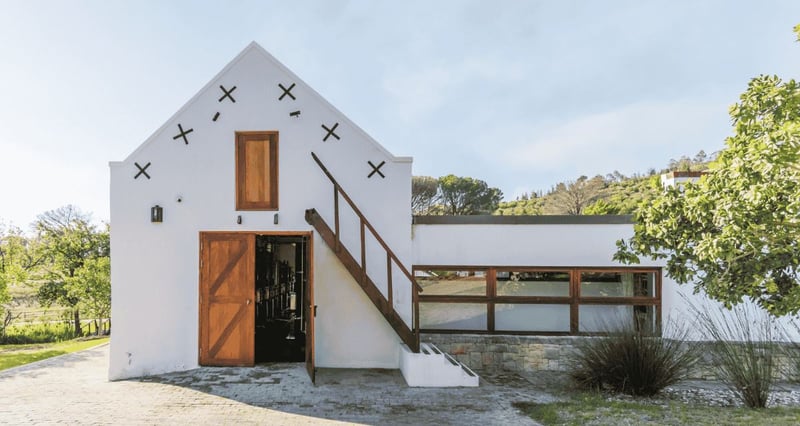
Druk-My-Niet Wine Estate dates back to 1692. After a devastating fire in 2017, German owners Dorothee Kirchner and her late husband, Georg, rebuilt the estate’s future while honouring its past.
Dorothee Kirchner and her late husband, Georg, always loved wine. Ex-banker Georg fantasised about the day he would own his very own wine farm. In 2002, the dream became a reality when they discovered the charming 24-ha estate, Druk-My-Niet, was eagerly awaiting new owners.
Druk-My-Niet used to be part of a much larger farm acquired in 1692 by French Huguenot François du Toit. He was the first to discover the route through the challenging Drakenstein Mountains, leading to Du Toitskloof Pass being named after him.
A few generations later, his son-in-law, Petrus Jacobus Malherbe, inherited this part of the estate. But he was unhappy with its small size, wedged between two larger pieces of land, so he named it Druk-My-Niet, Dutch for “don’t squeeze me”.
Georg and Dorothee wanted to transform the neglected guava farm into an estate that produces premium wines. They restored the houses and facilities to their former glory, and replanted some of the vineyards. The varieties now include Shiraz, Merlot, Cabernet Franc, Malbec and Chenin Blanc, and lesser-known but interesting varieties such as Tinta Barocca, Tempranillo, and Tannat, which also thrive there.
In 2017, a devastating veld fire destroyed all the thatched-roof buildings on the farm, including the original cellar and cottages.They also lost wine in the fire, as the cellar was set to bottle the week after the fire.
Determined to preserve the estate’s heritage, Dorothee and Georg collaborated with heritage committees and an architect to rebuild the structures. Within two years, the cottages were restored to their original style, complete with thatch roofs to maintain the farm’s authentic feel. The cellar was modernised, the irrigation system was redone, three hectares of vines were replanted and a 50-kW solar system made the farm more environmentally friendly.
The following year, winemaker Marcus Milner joined the estate, bringing with him decades of experience and a hands-on, minimal-intervention approach to winemaking. He grew up on a family farm just a kilometre from Warwick Estate, where he worked for nine years with Norma Ratcliffe before moving to De Meye Wines, where he spent 19 years. Initially involved in the horse racing business, he was the first in his family to venture into winemaking, although his brother, Alexander, is now also a winemaker. “Joining Druk-My-Niet after the fire felt like a chance to rebuild something meaningful,” he says.
He’s part of a small, close-knit team made up of administrator Carlien Fourie, who joined Druk-My-Niet 14 years ago, and Jonathen Olyn, the estate’s all-rounder and operations go-to person, who’s been at the estate for over 20 years. Other key team members include Gumisayi (Blessing) Zano, who tends the gardens, and Maria Bossmann, who helps manage the guest cottages and lends a hand in the vineyard during the season.
Connection to place Nestled among fynbos and mountain streams, Druk-My-Niet is situated on the northern side of Paarl at the base of the Hawekwa Mountains. Its distinctive terroir produces wines with a sense of place. Currently 11 ha are planted with vines.
On the farm’s south-facing slopes shale patches can be found among the ancient, decomposed granite soils. The pH levels remain low, helping to maintain good acidity even when the fruit is ripe. “It’s a huge help in creating balanced, structured wines,” Marcus says.
Because the granite soils don’t retain water well, the vines must delve extremely deep into the soil to find water in both the sublayers and bedrock. The roots also extract minerals and salts from the bedrock layers, lending a touch of minerality and salinity to the wines.
“Our soils and hot summers allow us to produce ripe, flavourful grapes while maintaining good acidity and structure, which is especially important in Mediterranean and Bordeaux-style reds,” Marcus says. While they produce some Chenin Blanc, they’re a red-focused estate due to the warmer conditions.
Keeping it simple Marcus calls himself a classic winemaker, although he enjoys experimenting. He’ll play with picking dates and skin contact times or let the wine go through malolactic fermentation on skins. He’s even tried natural fermentation, but ultimately he relies on traditional techniques. “I believe in expressing the vineyard rather than manipulating it.”
He describes his winemaking philosophy as working with nature. No man-made chemicals are used and fertilisation occurs naturally using a tea brewed by EcoSoil. The fynbos on the farm has been left untouched and the buck roam free and nibble on young shoots, which Marcus describes as “natural thinning”. “One year, they left me with only two tons of Merlot,” he says with a laughs.
The same approach applies in the cellar. Marcus says wine makes itself and you only step in when something goes wrong. “If grapes are a horse and the winemaker is a jockey, it’s far easier for a good horse to make a good jockey than a good jockey to make a good horse,” he says.
Marcus describes a complex wine as a great wine because it remains interesting to the palate. A truly great wine doesn’t just impress with the first sip. It evolves and deepens as you drink it. By the time you reach the last glass, you’re tempted to open another bottle.
This commitment to quality and authenticity has resonated with wine lovers locally and abroad. Druk-My-Niet wines are sold in South Africa and exported to select international markets, including Germany, Switzerland, England, Europe and Hong Kong.
Lasting impression The vision is to focus on a few exceptional wines, such as a Rubicon for Druk-My-Niet. Wines such as T3 and Invictus have the potential to become Druk-My-Niet’s flagship wines. “As for sustainability, we’ll keep doing what we do,” Marus says. Dorothee has also been getting more involved in new ideas, like starting a vegetable garden for the staff which they can manage themselves. It’s a small farm with a big heart.
The Druk-My-Niet team wants visitors to feel a genuine connection to the farm, whether they’re just coming for a wine tasting or staying in one of the cottages for the weekend. During harvest, Marcus invites visitors into the cellar to help sort grapes, stick their noses in the fermenting tanks and join in on the picking. It’s hands-on and people, especially international visitors, love it, he says. “Regarding the wine, I want people to know it’s honest. No shortcuts, no gimmicks. Just wine made for the love of wine.”
To explore more articles in our September issue, Home is where the wine is, purchase our digital or print magazine here.
Get new press articles by email
We submit and automate press releases distribution for a range of clients. Our platform brings in automation to 5 social media platforms with engaging hashtags. Our new platform The Pulse, allows premium PR Agencies to have access to our newsletter subscribers.
Latest from
- 7 Business Trends Your SME Can Leverage In 2026
- Sadilar Amplifies Visibility And Impact During Conference Season
- Future-ready Logistics- 5 Shifts TO Watch In 2026 (SUB-saharan Africa)
- Dunlop Urges Motorists To Prioritise Tyre Safety On The Busy Joburg To Cape Town Festive Route
- Poverty Trends Report Shows National Progress But Flags Growing Challenges In Gauteng
- SDG Challenge SA 2025 Highlights The Power Of Youth Innovation In Shaping A Sustainable Future
- Experienced Industry Leader Pauli Van Dyk Named Dean Of AFDA’s Upcoming Hatfield Campus
- South Africans Keep Tourism Alive As Homegrown Travel And Local Spending Rise
- Pretoria Student Wins Global Excel Esports Competition
- AfDB Steps Up Support For Somalia With $76m Investment In Roads And Regional Integration
- Corporate Law Experts Warn Directors Of Serious Consequences For Improper Transaction Approval
- New 3% Inflation Target Begins To Shift Expectations In South African Economy
- Retail As A Development Catalyst Drives New Africa Developments’ Inclusive Growth Strategy
- Collaborative SEF Model Shows How Civil Society And State Can Rebuild Economic Trust
- Shumani Accelerates Industrial Growth With Bheka Forklifts And New Equipment Plans For 2026
The Pulse Latest Articles
- Education Is The Frontline Of Inequality, Business Must Show Up (December 11, 2025)
- When The Purple Profile Pictures Fade, The Real Work Begins (December 11, 2025)
- Dear Santa, Please Skip The Socks This Year (December 10, 2025)
- Brandtech+ Has 100 Global Creative Roles For South African Talent (December 9, 2025)
- The Woman Behind Bertie: Michelle’s Journey To Cape Town’s Beloved Mobile Café (December 9, 2025)