
GIPCA presents NEGOTIATING THE ABSURD - MIGRATION AND CITIZENSHIP IN WILLIAM KENTRIDGE’S THE NOSE
Written by: Save to Instapaper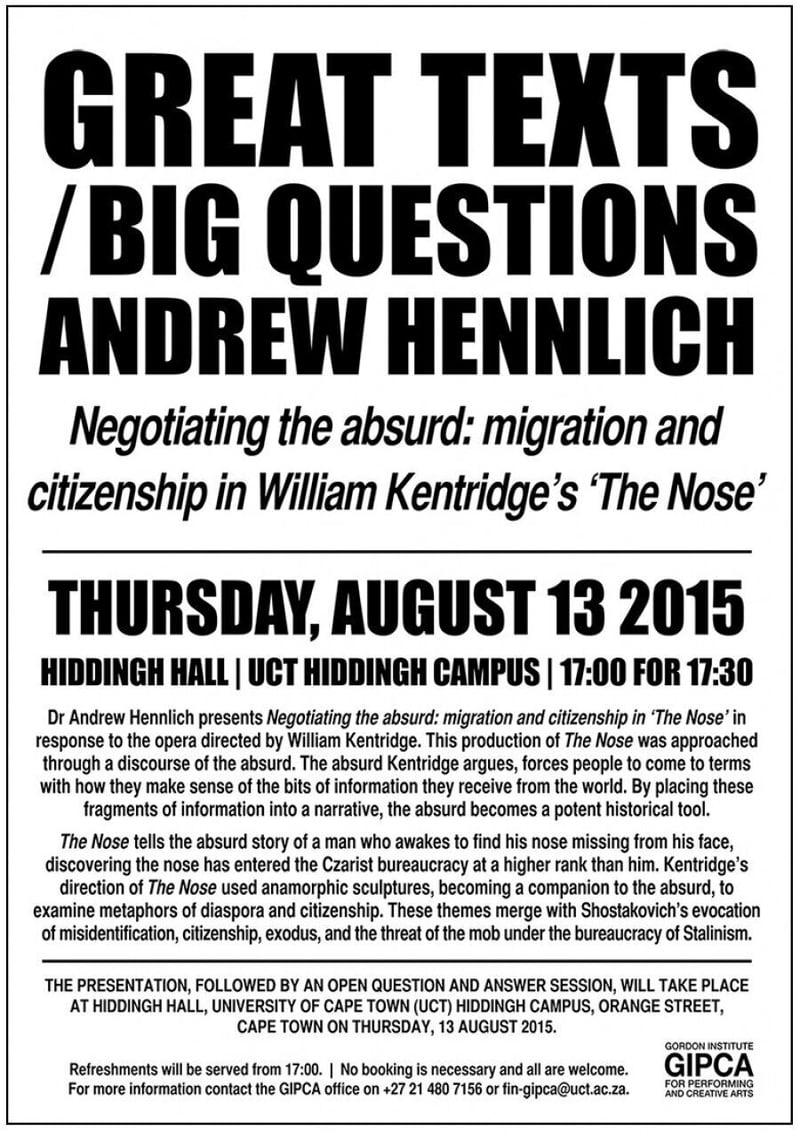
As part of its Great Texts / Big Questions series, the Gordon Institute for Performing and Creative Arts (GIPCA) presents Negotiating the absurd: migration and citizenship in The Nose by Dr Andrew Hennlich on Thursday, August 13th at UCT’s Hiddingh Hall, Gardens, Cape Town.
Assistant Professor of Art History at Western Michigan University, Dr Andrew Hennlich will present this lecture as a follow up to the presentation at GIPCA by renowned artist William Kentridge. Kentridge’s presentation, Putting the ‘S’ into Laughter in 2010, looked at Gogol’s short story The Nose. In 2009, Kentridge directed a new production of The Nose, (composer Dmitri Shostakovich’s first opera), which premiered at the Metropolitan Opera in New York. The Nose tells the absurd story of a man who awakes to find his nose missing from his face, discovering the nose has entered the Czarist bureaucracy at a higher rank than him.
Kentridge’s direction of The Nose used anamorphic sculptures, becoming a companion to the absurd, to examine metaphors of diaspora and citizenship. These themes merge with Shostakovich’s evocation of misidentification, citizenship, exodus, and the threat of the mob under the bureaucracy of Stalinism. According to Hennlich, this production of The Nose was approached through the discourse of the absurd. Kentridge derived his interpretation of the absurd from a photograph of the 2008 anti-immigrant riots, fueled by anxieties over unemployment and a lack of development in South Africa’s urban townships. The photograph published, in the Sunday Times shows protestors brandishing golf clubs, a curio giraffe, and a tetherball pole; using images of suburban leisure as weapons. The absurd Kentridge argues, forces people to come to terms with how they make sense of the bits of information they receive from the world.
By placing these fragments of information into a narrative, the absurd becomes a potent historical tool. Assistant Professor of Art History in the Gwen Frostic School of Art at Western Michigan University, Dr Hennlich is currently finishing a monograph, (un)Fixing the Eye: William Kentridge and the Optics of Witness, which reads the optical devices in Kentridge's animations and works for theatre as metaphors for the entwined relationships between witness, memory and history in South Africa.
He is also curating an exhibition After the Thrill is Gone: Fashion, Politics and Culture in Contemporary South African Art for the Richmond Center for Visual Art to open in 2016. The exhibition examines sartorial production referenced in contemporary South African art as a critical language for understanding the historical function of 'newness' in post-apartheid South Africa. Hennlich writes widely on contemporary art and politics including chapters in Film, History, Public Memory (Palgrave MacMillan, 2015), Making Futures (Plymouth College of Art, 2014), German Colonialism Revisited (University of Michigan Press, 2013), essays in esse, Image & Text, Rubric, etc., and catalogue essays for Julia Rosa Clark, Pierre Fouché, Daniel Halter, and Never Lopez.
The presentation, followed by an open question and answer session, will take place at Hiddingh Hall, University of Cape Town (UCT) Hiddingh Campus, 31 – 37 Orange Street, Cape Town on Thursday, August 13th 2015.
Refreshments will be served from 17:00. No booking is necessary and all are welcome.
For more information contact the GIPCA office on +27 21 480 7156 or This email address is being protected from spambots. You need JavaScript enabled to view it..
NOTE TO EDITORS About GIPCA: GIPCA facilitates new collaborative and interdisciplinary creative research projects in the disciplines of Music, Dance, Fine Art, Drama, Creative Writing, Film and Media Studies. Interdisciplinarity is a key theme of the institute and projects are imbued with innovation, collaboration and dialogue with urbanism and community. GIPCA was launched in December 2008 with a substantial grant from Sir Donald Gordon, founder of Liberty Life. An Advisory Board comprising Heads of Departments of all Performing and Creative Arts Departments at UCT helps to shape contexts for the instigation and development of projects by students and staff, as well as a wide range of institutions and individuals outside the University.
GIPCA Director: Associate Professor Jay PatherChair of the GIPCA Board: Professor Sakhela Buhlungu
ISSUED BY: The Gordon Institute for Performing and Creative Arts (GIPCA)
CONTACT: Samantha Saevitzon EMAIL: This email address is being protected from spambots. You need JavaScript enabled to view it. / This email address is being protected from spambots. You need JavaScript enabled to view it. TEL: 021 480 7156
Get new press articles by email
Latest from
- INTERNATIONAL AND NATIONAL SPEAKERS AT GIPCA’S PUBLIC ART SYMPOSIUM
- AWARD-WINNING NICOLA ELLIOTT’S ‘RUN!’ PREMIERES IN CAPE TOWN
- The Gordon Institute for Performing and Creative Arts (GIPCA), in association with STEVENSON, will present a talk by New York-based artist Wangechi Mutu.
- RUSTOM BHARUCHA REFLECTS ON TERROR AND PERFORMANCE AT GIPCA’S GREAT TEXTS
- GIPCA PRESENTS PRE-LIFE IN THE RUN-UP TO THE 2ND LIVE ART FESTIVAL
- GIPCA LAUNCHES 2ND LIVE ART FESTIVAL
The Pulse Latest Articles
- Education Is The Frontline Of Inequality, Business Must Show Up (December 11, 2025)
- When The Purple Profile Pictures Fade, The Real Work Begins (December 11, 2025)
- Dear Santa, Please Skip The Socks This Year (December 10, 2025)
- Brandtech+ Has 100 Global Creative Roles For South African Talent (December 9, 2025)
- The Woman Behind Bertie: Michelle’s Journey To Cape Town’s Beloved Mobile Café (December 9, 2025)