
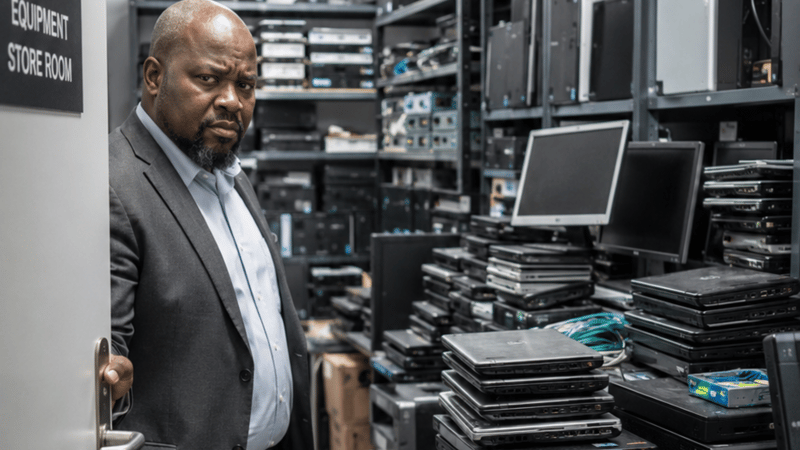
Walk into almost any business storeroom and you will probably find it.
Stacks of old laptops.
Boxes of monitors.
Networking equipment gathering dust.
Desktops sitting under desks.
Forgotten chargers tangled in drawers.
Most companies do not think of these items as money.
That is the problem.
Businesses lose millions through redundant IT assets every year, not because of fraud or theft, but because equipment quietly loses value while nobody is paying attention.
The decline rarely happens dramatically.
It happens one month at a time.
A laptop that could have recovered meaningful value six months ago now has battery issues.
A desktop that was once desirable becomes outdated.
Screens pick up scratches.
Chargers disappear.
Components are removed for other projects.
Market demand shifts.
Eventually, equipment that once represented significant capital becomes little more than electronic waste.
Why Value Disappears So Easily
The challenge is rarely that businesses do not care.
It is usually that nobody owns the process.
IT teams are focused on keeping operations running.
Finance departments may not have visibility into serial numbers or device condition.
Operations teams often avoid the risk of moving equipment that could still contain data.
Employees ask whether devices can be purchased internally.
Questions around security, transport, approvals, reporting, and compliance create delays.
So equipment sits and value disappears.
“What surprises most businesses is not how quickly equipment loses value, but how quietly it happens,” says Ryan Lurie, General Manager at Dispose-IT.
“We regularly see organisations storing equipment for years because there was never a clear process for what happens after devices leave production. By the time decisions are made, much of the recoverable value is already gone.”
The Hidden Value In Redundant Equipment
The reality is that redundant equipment often still has recoverable value.
Laptops, desktops, monitors, servers, networking equipment, tablets, and mobile devices frequently retain commercial value long after businesses stop using them.
But these assets follow a value curve, and every month of delay pushes them further down that curve.
Businesses often underestimate how much value is hidden in storage rooms.
A single unused laptop may not seem significant.
Hundreds of devices across multiple offices tell a different story.
Balancing Value Recovery With Security
The challenge is balancing value recovery with risk.
Recovering value should never come at the expense of security.
Every redundant device creates important questions:
Has the data been securely removed?
Can the equipment be resold safely?
Should it be reused internally?
Does it need recycling?
Can it be donated?
Who documents the process?
This is where structured IT asset disposal becomes less about disposal and more about control.
The Role Of Structured IT Asset Disposition
A professional IT asset disposition process creates structure around what is often a messy and delayed business problem.
Equipment is audited and assessed.
Devices are securely sanitised.
Assets are graded and categorised.
Equipment suitable for resale is identified.
Recyclable components are separated.
Reporting is created.
Value recovery opportunities become visible.
Finance teams gain clear records.
IT teams reduce risk.
Operations teams remove complexity.
“Most businesses do not actually have a disposal problem. They have a process problem,” says Lurie.
“Once organisations introduce structure around asset tracking, secure data sanitisation, grading, and recovery, they typically discover there is more value sitting in storage than they expected. The goal is not simply to remove equipment. It is to control risk while recovering value wherever possible.”
Controlled Value Or Uncontrolled Loss
The objective is not simply to dispose of equipment.
It is to prevent businesses from losing money they did not realise they were losing.
Because every redundant asset sitting on a shelf eventually becomes one of two things:
Controlled value or uncontrolled loss.
Press Release Submitted By
- Agency/PR Company: Dispose IT PR Account Manager
- Contact person: Lauren Omopariola
- Contact #: 27612268345
- Website
Get new press articles by email
The Pulse Latest Articles
- Knockout Chaos 2 Sets The Tone As Boxing Takes Centre Stage At Rpm Performance Gym (July 23, 2026)
- The Growth Of Trading Card Games (July 21, 2026)
- Why Supplier Verification Is No Longer Enough To Stop Fraud (July 20, 2026)
- Why Empathy, Not Algorithms, Is The Key To Unlocking South Africa’s Billion-rand Digital Economy (July 20, 2026)
- Thousands In Cape Town Gave Ladles Of Love A Hand (July 19, 2026)