
Roche on Early Breast Cancer Detection
Understanding the Myths That Delay Life-Saving Action
According to experts at Roche, early detection remains one of the most effective tools in the fight against breast cancer. Still, across Africa, many women delay or avoid screening because of misconceptions that have become all too common. These beliefs often stem from fear, cultural expectations, financial pressure or uncertainty about what screening entails.
Clarifying these myths is essential, because timely action both improves outcomes and protects the stability of families, households and communities.
Myth 1: “If I feel fine, I don’t need to get checked.”
Some breast cancers cause no pain, discomfort or visible symptoms. Routine self-checks and regular screenings are designed to identify changes long before physical signs appear.¹ Early detection at this stage dramatically improves the likelihood of successful treatment.2
Myth 2: “Breast cancer only affects older women.”
Breast cancer is not confined to older women. Breast cancer, the most prevalent cancer among South African women, is increasingly being detected in women under 40; during years that are economically productive and deeply family-centred. Screening early protects both health and livelihood.3
Myth 3: “Screening is too expensive.”
Medical aids or community health partners cover breast examinations and, in some cases, self-sampling options for related women’s cancers.4
The greater financial burden lies in later-stage disease, where treatment may become more complex, more invasive, and more costly; both medically and personally.
Myth 4: “A diagnosis is the end.”
A diagnosis is not an ending. It is the pathway to support, clarity and evidence-based treatment. When breast cancer is found early, and is still in its localised stage (confined to the breast), and before it spreads, survival can reach up to 99 percent.5,6 Advances in diagnostics and targeted therapies continue to improve outcomes, helping women live longer, healthier lives.
Myth 5: “I don’t have the time to check.”
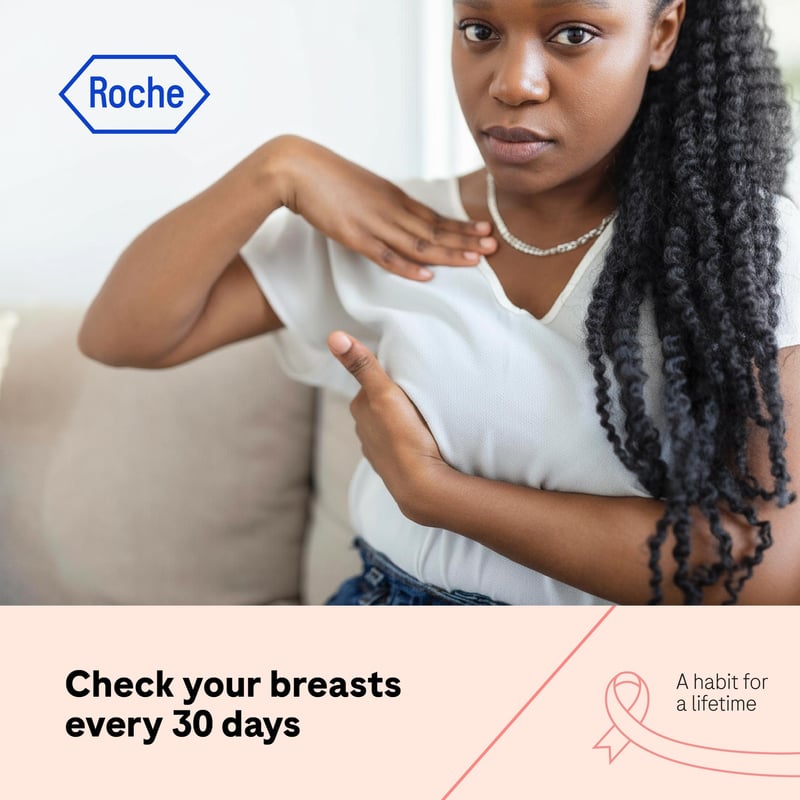
A breast self-check takes around five minutes. That is far less than most daily routines that protect our wellbeing, such as stretching, hydrating or applying sunscreen.7
This small monthly act strengthens awareness, builds familiarity with one’s own body, and allows changes to be identified early.
Myth 6: “Breast cancer runs in my family — there’s nothing I can do.”
Family history may play a role, but it is only one piece of a larger picture. Healthy nutrition, regular physical activity, maintaining a stable weight and limiting alcohol are all proven ways to reduce risk.8,9 Understanding genetic or family patterns may empower earlier action. It does not remove agency.
Myth 7: “I’m too afraid to know.”
Fear of the unknown is powerful, but it is uncertainty, not action, that creates the greatest risk. Women who know the warning signs, including new lumps, dimpling, nipple changes or discharge, are able to act decisively and seek medical advice.10
Courage grows from information, not avoidance.
Why early action matters
Healthy habits protect long-term wellbeing, but no lifestyle approach replaces the value of early detection.11
A monthly five-minute check, supported by regular clinical screening when possible, is a small gesture of self-care that carries profound potential. It can safeguard a life, preserve a family’s stability and protect the heart of a community.
Because every habit has a purpose. And this one may save your life.
M-ZA-00002790 expiration date: 12.12.2027
References
CDC. Symptoms of Breast Cancer (2025).
https://www.cdc.gov/breast-cancer/symptoms/index.html, accessed 03 December 2025.
WHO. Breast Cancer: Fact Sheet (2025)
https://www.who.int/news-room/fact-sheets/detail/breast-cancer, accessed 03 December 2025.
Medpharm Publications: Breast Cancer on the Rise in Younger South African Women https://medpharm.co.za/home-featured/breast-cancer-on-the-rise-in-younger-south-african- women/, accessed 03 December 2025
Discovery: Self-Sampling for Cancer Screening (2025) https://www.discovery.co.za/wcm/discoverycoza/assets/health_professionals/propbm-com muniques/self-sampling-cancer-screening-handbook.pdf, accessed 03 December 2025.
National Breast Cancer Foundation: Breast Cancer Facts & Stats https://www.nationalbreastcancer.org/breast-cancer-facts/ , accessed 03 December 2025
WHO. Breast Cancer: Fact Sheet (2025).
https://www.who.int/news-room/fact-sheets/detail/breast-cancer, accessed 03 December 2025
National Breast Cancer Foundation. Healthy Habits (2025). https://www.nationalbreastcancer.org/healthy-habits, accessed 03 December 2025
American Cancer Society. Guideline for Diet and Physical Activity (2025). https://www.cancer.org/cancer/risk-prevention/diet-physical-activity/acs-guidelines-nutritio n-physical-activity-cancer-prevention/guidelines.html, accessed 03 December 2025
Farvid, M.S. et al. Diet Quality and Breast Cancer Outcomes. Cancer Epidemiol Biomarkers Prev (2021). https://pubmed.ncbi.nlm.nih.gov/33773535/, accessed 03 December 2025
MyBreast (SA). Symptoms of Breast Cancer (2025).
https://www.mybreast.org.za/breast-health/breast-cancer/what-are-the-symptoms-of-breas t-cancer/, accessed 03 December 2025
National Breast Cancer Foundation. Healthy Habits (2025). https://www.nationalbreastcancer.org/healthy-habits, accessed 03 December 2025
Release information
Issued on behalf of
Roche
Media contact
JNPR
Gabrielle Matthew