
SA’s 2026 Offshore Allowances - Euro Assets, Yield, European Residence and Schengen Access
Written by: Andrew J. Taylor Save to Instapaper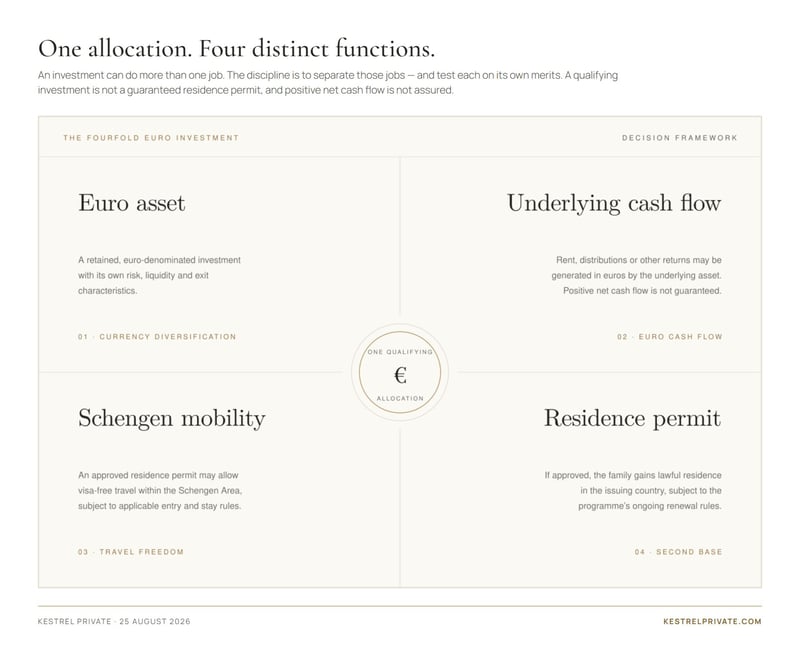
South Africans building an offshore structure or seeking a second base in Europe can now compare the full funding requirement with their available 2026 offshore allowances before committing to a qualifying property or fund.
Kestrel Private has released a Europe-only planning guide covering five residence-by-investment cases in Greece, Cyprus and Portugal. Every case involves a retained foreign asset. Citizenship contributions and other non-investment programmes are deliberately excluded.
The guide models not only the qualifying property price or fund subscription, but also the foreign taxes, VAT, government charges and professional costs that may have to be paid offshore.
"South Africa's offshore allowances function as annual strategic windows for building an offshore position. While the limits define how much can be funded in a single year, they remain sufficient for most families considering these programmes. For those who already hold assets offshore, reallocating 15–20% of an existing portfolio into a qualifying euro investment is often a straightforward diversification decision. The objective is for that capital to perform four roles simultaneously: remain invested as a hard-currency euro asset, generate potential euro income, establish a European residence position, and provide greater travel flexibility within the Schengen Area."
— Andrew J. Taylor, Founder and Managing Partner, Kestrel Private
TWO STARTING POINTS
The guide frames every case around one question: where does the capital sit today?
For a family building its offshore position, the core annual investment route is the R10,000,000 foreign capital allowance available to each qualifying individual through SARS's Approval International Transfer (AIT) process. A separate R2,000,000 Single Discretionary Allowance (SDA) is also available to each qualifying adult and may be used for permitted international transactions, including investment.
That creates potential annual offshore capacity of up to R12,000,000 per qualifying adult, or up to R24,000,000 where two qualifying spouses each use their own capacity.
For planning purposes, however, the guide treats the R10 million foreign capital allowance, accessed through the AIT process, as the core investment capacity rather than assuming the full SDA will also be committed. The SDA is used for travel, foreign card expenditure and other international transactions, so retaining some or all of it provides useful flexibility during the remainder of the calendar year.
The planning question is therefore not simply whether an advertised investment threshold fits within an allowance. It is whether the complete offshore funding requirement — the qualifying investment plus foreign taxes, VAT and transaction, application and professional costs — can be funded efficiently from the capacity actually available to the individual or family.
For a family whose capital is already offshore, no new South African allowance is required to deploy capital that was lawfully externalised in an earlier year and remains abroad. The decision becomes one of reallocation: ring-fence a defined portion of the established offshore portfolio — the guide illustrates 15% — and apply it to a qualifying Greek or Cypriot property or an eligible Portuguese fund.
The same capital then performs a different role: it remains a retained euro-denominated asset while potentially generating income and supporting a European residence application, subject to programme eligibility, due diligence and government approval.
WHAT ONE INDIVIDUAL'S R10 MILLION AIT CAPACITY COVERS
Using the deliberately rounded planning rate of EUR 1 = R19, one individual's R10,000,000 foreign capital allowance represents approximately EUR 526,000 of offshore funding.
For this reason, the guide models the complete funding requirement, not simply the advertised minimum investment.
Greece illustrates the range clearly. A EUR 250,000 qualifying conversion or restoration property models at approximately EUR 280,000, or R5,320,000 all-in. At the upper end of what can comfortably fit inside one individual's R10 million foreign capital allowance, a property of approximately EUR 475,000 models at roughly R9,870,000 all-in.
Cyprus follows a similar pattern. The EUR 300,000 plus VAT entry case models at approximately EUR 375,000, or R7,125,000 all-in. A property of approximately EUR 425,000 models at roughly R9,950,000.
These figures deliberately use the R10 million foreign capital allowance as the primary planning boundary. They do not assume that the individual's additional R2 million SDA will be exhausted.
That distinction matters because a transaction marginally above R10 million may still be achievable by using a portion of the SDA, while leaving the balance available for other international expenditure.
THE THRESHOLD IS NOT THE TRANSFER AMOUNT
At Kestrel Private's deliberately rounded planning rate of EUR 1 = R19, the five cases map as follows:
GREECE — Qualifying conversion or restoration property
Advertised asset threshold: EUR 250,000
Modelled euro requirement: approximately EUR 280,000
Rand requirement: R5,320,000
Indicative South African route: One individual's R10,000,000 foreign capital allowance through AIT
Remaining foreign capital allowance capacity: R4,680,000
SDA required: None
GREECE — Standard regional property
Advertised asset threshold: EUR 400,000
Modelled euro requirement: approximately EUR 440,000
Rand requirement: R8,360,000
Indicative South African route: One individual's R10,000,000 foreign capital allowance through AIT
Remaining foreign capital allowance capacity: R1,640,000
SDA required: None
GREECE — Prime-area property
Advertised asset threshold: EUR 800,000
Modelled euro requirement: approximately EUR 865,000
Rand requirement: R16,435,000
Indicative South African route: Capacity from two qualifying individuals, typically spouses, with each transfer separately documented
Combined R20,000,000 foreign capital allowance capacity remaining after the modelled transaction: R3,565,000
SDA required: None
CYPRUS — Qualifying new property
Advertised asset threshold: EUR 300,000 plus VAT
Modelled euro requirement: approximately EUR 375,000
Rand requirement: R7,125,000
Indicative South African route: One individual's R10,000,000 foreign capital allowance through AIT
Remaining foreign capital allowance capacity: R2,875,000
SDA required: None
PORTUGAL — Qualifying investment fund
Advertised asset threshold: EUR 500,000
Modelled euro requirement: approximately EUR 540,000
Rand requirement: R10,260,000
Indicative South African route: R10,000,000 through one individual's foreign capital allowance via AIT, plus R260,000 from that individual's SDA
Remaining SDA after the modelled transaction: R1,740,000
The Portugal example illustrates why the R2 million SDA can be useful as a buffer rather than something that needs to be fully deployed. At the planning rate, the complete modelled position exceeds the R10 million foreign capital allowance by only R260,000. That amount can be funded from the individual's SDA while leaving most of the SDA untouched.
Alternatively, the R260,000 could come from a spouse's own available capacity or from capital already lawfully held offshore.
These are indicative two-adult planning cases, not fixed quotations. The euro figures include the qualifying investment and modelled foreign taxes, VAT and transaction, application and professional costs. Family composition, the selected property or fund, professional advisers, banking arrangements and the live exchange rate will determine the final amount.
For Cyprus, the EUR 375,000 model conservatively assumes standard 19% VAT and does not assume a reduced rate or any VAT recovery. Any potential recovery depends on the acquisition, ownership and use structure and must be confirmed by a Cyprus tax adviser before purchase.
The EUR 475,000 Greek and EUR 425,000 Cypriot property figures are planning ceilings modelled on the same cost assumptions as the cases above. They illustrate approximately how much qualifying property can be acquired while keeping the complete funding requirement inside one individual's R10 million foreign capital allowance.
WHAT THE ALLOWANCE CALCULATION ACTUALLY MEANS
There are three distinct sources of offshore funding that should not be confused: the R10 million foreign capital allowance through AIT, the separate R2 million Single Discretionary Allowance, and capital already lawfully held offshore.
R10,000,000 PER QUALIFYING INDIVIDUAL, PER CALENDAR YEAR
A South African resident individual who is 18 years or older and a taxpayer in good standing may transfer up to R10 million per calendar year for foreign investment through an Authorised Dealer under the foreign capital allowance.
The individual must obtain the required Approval International Transfer (AIT) from SARS and provide the applicable TCS PIN. The Authorised Dealer — generally the client's bank — must verify the tax-compliance position and satisfy itself as to the transaction, source of funds and applicable exchange-control requirements before releasing the transfer.
The R10 million limit applies per individual, not per household. Where two spouses each qualify, each has their own R10 million annual capacity and completes their own process. Their allowances do not become one pooled R20 million allowance simply because they are married.
R2,000,000 SINGLE DISCRETIONARY ALLOWANCE PER ADULT, PER CALENDAR YEAR
In addition to the R10 million foreign capital allowance, a South African resident individual aged 18 or older has a R2 million Single Discretionary Allowance per calendar year.
The SDA may be used for legal purposes abroad, including investment, but it is also the allowance used for other international transactions such as travel and foreign expenditure.
This means a qualifying individual can potentially have up to R12 million of annual offshore capacity, while two qualifying spouses can potentially have up to R24 million between them.
Kestrel Private does not, however, assume that the full R2 million SDA should automatically be committed to an investment. Where the R10 million foreign capital allowance is sufficient, preserving the SDA leaves the client with flexibility for other international transactions during the remainder of the year.
Where a transaction falls only slightly above R10 million, as in the modelled Portugal case, using part of the SDA can be an efficient way to close the difference without requiring a second taxpayer or capital already held offshore.
FUNDS ALREADY HELD OFFSHORE
Capital that was lawfully externalised in an earlier year and remains offshore can generally be applied to a new foreign investment without consuming the current year's R10 million foreign capital allowance or R2 million SDA.
The source-of-funds, banking and KYC trail still needs to be complete, but there is an important planning distinction: using existing authorised offshore capital is a reallocation, not a new externalisation from South Africa.
A family that has spent several years building an offshore portfolio may therefore have considerably more investment capacity than the current year's allowances alone suggest.
The practical question is not simply, "What is this year's allowance?" It is:
How much capacity remains under each individual's current-year allowances, how much capital is already held offshore, and what is the complete funding requirement of the proposed investment?
At the modelled planning rate, the EUR 540,000 Portugal case equals R10.26 million. One individual could therefore fund R10 million through the foreign capital allowance using the AIT process and R260,000 through the SDA, leaving R1.74 million of the SDA available. A spouse's separate capacity or existing offshore funds could equally fund the excess.
WHERE THE SPOUSE BECOMES IMPORTANT
The modelled EUR 865,000 Greek prime-area case equals approximately R16.435 million and therefore exceeds one individual's R10 million foreign capital allowance.
For two qualifying spouses, however, the position is very different. Each spouse has their own R10 million foreign capital allowance and their own R2 million SDA. The household may therefore have potential annual offshore capacity of up to R24 million, although each allowance remains legally and administratively attached to the individual who uses it.
In the modelled Greek case, there is no need to use either spouse's SDA. On an illustrative equal funding split, each spouse would contribute approximately EUR 432,500, or R8,217,500 — comfortably within each individual's R10 million foreign capital allowance.
Greek law permits spouses to hold a qualifying property in undivided co-ownership at the applicable property threshold. The South African funding should therefore be structured to correspond properly with the proposed ownership and payment arrangement.
This does not create a pooled South African allowance. Each spouse makes their own AIT application, obtains their own TCS PIN for the approved amount and makes an identifiable transfer using their own capacity.
Where both spouses are funding the acquisition, the proposed title shares, payment allocation and banking route should be agreed with the Authorised Dealer and the Greek lawyer and notary before funds are released.
Funds already lawfully held offshore can also form part of the acquisition without consuming either spouse's current-year allowance, provided the source-of-funds and KYC trail is complete.
A personal Greek bank account is not necessarily required for the acquisition. Payment may be structured by credit transfer to the properly documented beneficiary or escrow arrangement, subject to the route being accepted in advance by the client's Authorised Dealer and the Greek lawyer and notary.
ONE ALLOCATION, FOUR DISTINCT FUNCTIONS
A properly selected European investment can potentially perform four separate roles:
Euro asset — a retained, hard-currency, euro-denominated property or fund interest.
Underlying cash flow — potential rental income, fund distributions or capital growth in euros. Positive returns or cash flow are not guaranteed.
Residence position — a renewable or permanent European residence permit, depending on the programme.
Schengen mobility — greater travel flexibility under the rules attached to the relevant residence permit.
The outcomes are not identical across countries. Greece and Portugal issue residence permits within the Schengen Area. Cyprus provides permanent residence in an EU member state, but Cyprus is not yet fully part of the Schengen Area and should not be presented as a Schengen-access programme.
Income, distributions and capital growth are investment outcomes rather than guarantees. Greek Golden Visa properties are also subject to specific use restrictions, including restrictions on short-term letting. Each property or fund must therefore be assessed on its own investment merits as well as its residence eligibility.
WHAT A FILE USUALLY INVOLVES
Price the whole position, not the advertised threshold. The qualifying investment plus foreign taxes, VAT and transaction, application and professional costs is the number that ultimately has to be funded offshore.
Map the available funding. Check the R10 million foreign capital allowance remaining for each qualifying individual, how much of each R2 million SDA should reasonably remain available, and what capital is already lawfully held offshore.
Confirm the asset, ownership and payment structure. Who owns the qualifying investment, in what proportions, and who makes each payment must be consistent with the foreign legal structure and the South African funding route.
Complete the required AIT process. Where the R10 million foreign capital allowance is being used, obtain the relevant SARS approval and TCS PIN and agree the transfer route with the Authorised Dealer.
Transfer and preserve the audit trail. Keep the banking records, SARS documentation, source-of-funds evidence, title documents and residence records together.
The allowances operate on a calendar-year basis. Unused capacity does not increase the standard allowance available in the following year.
Kestrel Private's advice is not to externalise capital merely because an allowance is available. The objective is to plan early enough that a genuine European investment can be completed through the appropriate individuals, ownership interests and banking routes, while avoiding unnecessary use of the SDA where possible.
ABOUT KESTREL PRIVATE
Kestrel Private is a principal-led private-client advisory firm headquartered in Cape Town. It coordinates European residence by investment and the qualifying investments and ownership arrangements supporting it through one senior client relationship.
EDITOR'S NOTE
The complete European funding guide and accompanying one-page media reference are available as publication-ready PDFs from kestrelprivate.com.
Press kit: https://kestrelprivate.com/media-kit/2026-offshore-allowance/
Greece — residence by investment: https://kestrelprivate.com/residence/greece
Cyprus — EU permanent residence: https://kestrelprivate.com/residence/cyprus
Portugal — investment fund route: https://kestrelprivate.com/residence/portugal
Greek thresholds, with the article and sources: https://kestrelprivate.com/greece-golden-visa
If you publish, the programme pages above are the correct destinations for Greece, Cyprus and Portugal.
SOURCE AND METHODOLOGY NOTE
South African allowance references: the SARB Currency and Exchanges Manual for Authorised Dealers, SARB Exchange Control Circular 6/2026 and SARS supporting-document guidance for Approval International Transfers. Programme references include Article 64 of Greek Law 5100/2024, the Greek National Registry's Article 100 conversion procedure, the Cyprus Migration Department's investor-permit criteria, the Cyprus Tax Department's VAT guidance and Portugal AIMA's EUR 500,000 collective-investment route. Cyprus's current Schengen position is reflected in the European Commission's official Schengen overview. Planning rate: EUR 1 = R19. The rate is deliberately rounded but does not replace a bank's signed live quotation. All amounts are indicative planning examples, not quotations, investment recommendations, tax advice, legal advice or exchange-control approval. Programme terms, investment performance, taxes, costs, exchange rates and official classifications can change. Final routing rests with the client's Authorised Dealer, SARS and, where applicable, the South African Reserve Bank's Financial Surveillance Department. Foreign eligibility and title arrangements must be confirmed by the relevant licensed professionals before funds are transferred.
— ENDS —
© Kestrel Private · Cape Town · kestrelprivate.comPress release · 25 August 2026
Press Release Submitted By
- Agency/PR Company: Kestrel Private
- Contact person: Media Relations
- Contact #: 087 813 4027
- Website
Get new press articles by email
The Pulse Latest Articles
- Women Shaping Ai Global Creative Work From South Africa (August 25, 2026)
- Women’s Month Ends In August. Accountability Shouldn’t. (August 25, 2026)
- Ai In Job Profiling: When Efficiency Becomes A Risk (August 24, 2026)
- Women Are Performing While Physiologically Depleted (August 24, 2026)
- Kwv Marks 100 Years Of Brandy-making With Top Two Scores At Iwsc South Africa Judging (August 20, 2026)