
Google Ads vs SEO - What Should South African Small Businesses Actually Invest In?
Written by: Bubble Bekkie Advertising (PTY) Ltd Save to Instapaper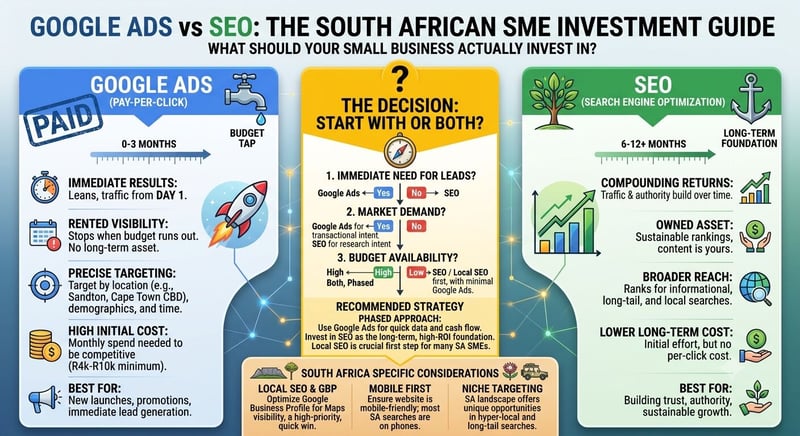
An investigative look at paid search, organic visibility and the digital marketing decisions that can make or break a small business
For a small business owner in South Africa, deciding where to spend a limited marketing budget can be difficult. Google Ads promises immediate paid visibility. Search engine optimisation, commonly known as SEO, promises the opportunity to build organic visibility over time. Social media offers another route to customers, while websites, Google Business Profiles and online directories all contribute to how a company is discovered and evaluated.
The problem is that many businesses are still asking the wrong question.
They ask:
Google Ads vs SEO: What Should South African Small Businesses Actually Invest In?
The more useful question is whether the business understands what each channel is designed to achieve, how long results are likely to take, how success will be measured and whether the website is capable of converting the attention generated by the marketing investment.
The difference matters.
A business can spend money on Google Ads and generate clicks without generating customers. It can invest in SEO without understanding what its potential customers actually search for. It can build a professional website that nobody discovers. It can rank for keywords that generate traffic but have little commercial value.
In other words, digital marketing can create plenty of activity without necessarily creating business growth.
This investigation examines the real differences between Google Ads and SEO, the questions South African small businesses should be asking before investing, and why the right answer is rarely as simple as choosing one over the other.
Google Ads vs SEO: What Is the Actual Difference?
Google Ads and SEO both aim to improve a business's visibility when people search online, but they operate through fundamentally different systems.
Google Ads is paid advertising.
A business creates an advertising campaign, chooses its targeting and budget, develops advertisements and directs potential customers towards a relevant destination, such as a website or landing page.
Google explains that advertisers can set budgets and use different bidding strategies depending on their objectives, including strategies focused on clicks, leads or conversions. Google also notes that an average daily budget controls overall campaign spending, although actual daily spend can vary depending on the campaign and Google's delivery system.
SEO is different.
Search engine optimisation involves improving a website and its content so that search engines can understand the website and potentially surface its pages for relevant searches.
SEO can involve:
Technical website optimisation.
Website architecture.
Mobile usability.
Page performance.
Search intent.
Helpful content.
On-page optimisation.
Internal linking.
Local SEO.
Structured information.
Business information.
Digital authority.
Relevant third-party references.
The fundamental difference is therefore simple.
Google Ads is paid visibility.
SEO is the process of improving a website's organic search visibility.
However, that simple distinction becomes much more complicated when we consider how people actually make purchasing decisions.
A customer might first discover a business through a Google advertisement.
They might then visit the website.
Before making contact, they might search the company's name.
They could look at reviews.
They might check the company's social media profiles.
They may search for competitors.
They could even ask an AI system for recommendations.
The customer journey is no longer necessarily one search followed by one click.
That is why businesses need to think beyond individual marketing channels.
Which Is Better, Google Ads or SEO?
There is no universal answer.
Any agency or marketer claiming that Google Ads is always better than SEO, or that SEO is always better than Google Ads, is ignoring the circumstances that make each strategy effective.
The appropriate choice depends on factors such as:
The business's objectives.
The industry.
The level of competition.
The available budget.
The value of a new customer.
The sales cycle.
The geographic market.
The website's quality.
The existing organic visibility.
The urgency of generating leads.
Consider two businesses.
The first is a new company launching a service in a competitive market. It has a new website and very little existing organic visibility. It needs enquiries quickly.
The second is an established business that has operated for several years, has a strong website and already receives organic traffic. It wants to build long-term visibility and reduce its dependence on paid advertising.
These businesses may require completely different strategies.
The first may benefit from paid search while building its SEO foundations.
The second may have a stronger opportunity to invest in organic growth.
Neither approach is automatically "better".
The right strategy depends on the business.
Is SEO Better Than Google Ads?
SEO can be a powerful long-term investment, but that does not make it universally better than Google Ads.
One of the major attractions of SEO is that businesses do not pay Google for every organic click in the same way they pay for an advertising click.
However, SEO is not free.
A serious SEO strategy requires investment in research, technical work, content, optimisation, monitoring and ongoing improvements.
There is also no guarantee that a business will achieve a specific ranking by a specific date.
Organic search visibility is influenced by numerous factors, including competition, relevance, technical quality, content and the overall strength of a website.
This creates an important distinction.
A business should not compare SEO and Google Ads simply by asking:
"Which one costs less?"
It should ask:
"Which investment is most likely to support my business objective?"
A business that needs leads immediately may prioritise paid advertising.
A business building a long-term digital presence may prioritise SEO.
A business with enough resources may use both.
Is Google Ads Worth It for a Small Business?
Google Ads can be worthwhile for small businesses, but simply running advertisements does not guarantee success.
Google's own documentation explains that advertisers can choose their budgets and adjust them according to their goals. Google also provides bidding strategies designed around different objectives, including generating clicks or conversions.
The challenge is what happens after the advertisement is clicked.
A campaign can generate traffic but fail to generate customers.
Why?
Because the problem may not be the advertisement.
The problem may be the destination.
A potential customer clicks an advertisement and arrives at a website that:
Loads slowly.
Looks outdated.
Does not work properly on mobile.
Does not clearly explain the service.
Has no obvious call to action.
Does not display sufficient trust signals.
Makes contacting the business difficult.
Contains confusing or incomplete information.
The advertising campaign may then be blamed for poor results when the real problem is the customer journey.
This is why businesses should never evaluate Google Ads solely by asking how many clicks they received.
The more important questions are:
How many qualified enquiries were generated?
How many sales resulted?
What did it cost to acquire each customer?
Was the revenue generated greater than the marketing cost?
A click is an action.
It is not a business result.
How Much Should a Small Business Spend on Google Ads?
There is no universal budget that applies to every business.
Google allows advertisers to establish average daily budgets and adjust them according to campaign requirements. Google also explains that actual daily spending can vary, with monthly charging limits based on the average daily budget for most campaigns.
The appropriate advertising budget depends on the economics of the business.
For example, a business selling a low-cost product will have a different customer acquisition model from a professional service provider selling a high-value service.
Important considerations include:
Average customer value.
Profit margin.
Conversion rate.
Cost per click.
Competition.
Geographic targeting.
Lead quality.
Customer lifetime value.
This is why generic advice such as "spend R100 a day" or "spend R10,000 a month" should be treated carefully.
A budget should be connected to a business objective.
The question is not simply:
"How much can I spend?"
The better question is:
"What can I afford to spend to acquire a customer while remaining profitable?"
That is a business calculation, not simply a marketing decision.
How Long Does SEO Take?
One of the biggest misunderstandings surrounding SEO is the expectation of immediate results.
SEO can take time.
The timeframe varies significantly between businesses and industries.
A new website competing for highly competitive national keywords may face a very different challenge from an established local business targeting a specific service area.
SEO performance can be influenced by:
Competition.
Website history.
Technical quality.
Content relevance.
Search demand.
Website authority.
Local relevance.
Search intent.
The quality of the overall digital presence.
This is why responsible SEO providers should be careful about promising guaranteed rankings.
A professional SEO strategy should explain what is being done, why it is being done and how progress will be measured.
The objective should not simply be to rank for a keyword.
The objective should be to attract relevant people who are more likely to become customers.
Ranking for a keyword that nobody searches for is not a meaningful victory.
Ranking for a highly searched keyword that attracts people who will never buy from the business is also not necessarily a meaningful victory.
The real value lies in connecting the right search intent with the right business offering.
Can SEO Replace Google Ads?
For some businesses, SEO can reduce dependence on paid advertising.
But SEO cannot automatically replace Google Ads for every business.
Paid advertising and organic search serve different purposes.
Google Ads can provide paid visibility when a campaign is active and funded.
SEO can build organic visibility that may continue to generate traffic after the initial optimisation work has been completed.
However, SEO also requires maintenance.
Competitors continue publishing.
Search behaviour changes.
Websites change.
Businesses launch new services.
Products become outdated.
Search engines evolve.
A website that was well optimised two years ago may not necessarily remain competitive forever.
The most realistic way to view SEO is therefore not as a one-time project, but as an ongoing digital asset that requires attention.
What Happens When You Stop Paying for Google Ads?
When a Google Ads campaign stops running, the paid advertising visibility associated with that campaign stops.
The business is no longer paying to appear through those advertisements.
This is one of the fundamental differences between paid and organic search.
Google's advertising system is directly connected to campaign budgets and advertising settings. Google states that advertisers can change their average daily budgets and that budget changes can affect how frequently advertisements are shown.
This does not mean that a business should avoid paid advertising.
It means that businesses should understand what they are buying.
Google Ads buys access to paid advertising opportunities.
SEO works towards organic visibility.
They are different investments.
What Happens When You Stop SEO?
Stopping active SEO work does not necessarily mean that a website immediately disappears from organic search results.
If a website has built strong organic visibility, some rankings may continue.
However, the digital environment does not stand still.
Competitors may improve their websites.
New businesses may enter the market.
Search behaviour may change.
Content may become outdated.
Technical problems may develop.
Google's systems may evolve.
For this reason, businesses should consider SEO as part of ongoing digital development rather than a switch that is simply turned on and off.
The amount of ongoing work required will depend on the industry, competition and objectives.
A local business operating in a less competitive market may have different needs from a national company competing in a highly competitive industry.
Can Google Ads Help SEO?
This question requires a careful answer.
Businesses should not assume that spending money on Google Ads directly improves their organic Google rankings.
Paid advertising and organic search are separate systems.
However, paid advertising can provide useful information that may influence broader marketing decisions.
For example, a business may learn:
Which messages generate interest.
Which offers attract customers.
Which locations perform best.
Which services generate enquiries.
Which landing pages convert.
Which search terms attract commercial intent.
These insights may help inform broader marketing strategy.
But that is very different from saying that Google Ads directly improves organic rankings.
Businesses should be wary of anyone promising that simply spending more on Google Ads will cause their organic SEO rankings to improve.
Which Is Better for a New Business?
A new business needs to consider both immediate visibility and long-term digital growth.
If the business needs enquiries quickly, paid advertising may provide an opportunity to reach people searching for relevant products or services.
At the same time, the business should build its organic foundation.
That may include:
A professional website.
SEO.
Local SEO.
Google Business Profile optimisation where eligible.
Helpful content.
Accurate business information.
Reviews.
Relevant third-party mentions.
A consistent digital presence.
This is particularly important because search itself is evolving.
Google's current AI search features are changing how users interact with search results, while research published in 2026 indicates that AI-generated search experiences can retrieve sources differently from traditional search results. One recent study comparing Google Search, AI Overviews and generative search systems found substantial differences in the sources retrieved across these environments.
The implication for businesses is significant.
Digital visibility is no longer simply about having a website.
It is about building a website and digital presence that can be discovered, understood and trusted.
Can a Small South African Business Compete With Larger Companies?
Yes, but competing does not necessarily mean trying to outrank large corporations for every broad keyword.
A small business can often compete more effectively by focusing on:
Specific services.
Geographic areas.
Niche markets.
Local search.
Industry expertise.
First-hand experience.
Helpful content.
A small South African business may struggle to compete nationally for an extremely broad term such as "digital marketing".
But it may have a much stronger opportunity to become visible for more specific searches related to its services, location and target market.
This is where strategy becomes important.
The objective should not be:
"How do I beat the biggest company online?"
The objective should be:
"Where are my most valuable customers searching, and how can I become the most useful and credible result for those searches?"
That is a much more realistic approach.
The Hidden Cost of Choosing the Wrong Digital Marketing Strategy
The biggest cost of poor digital marketing is not always the money spent.
Sometimes it is the time lost.
A business can spend months targeting irrelevant keywords.
It can spend thousands on advertising without proper conversion tracking.
It can publish hundreds of social media posts without a clear customer journey.
It can invest in a website that looks attractive but is difficult to find.
It can pay for SEO without understanding what work is actually being performed.
It can focus on traffic instead of revenue.
These mistakes are costly because digital marketing is connected to business opportunity.
Every month spent on the wrong strategy is a month in which competitors may be improving their visibility.
Every advertising rand spent without measurement is a rand whose commercial value may be unclear.
Every website built without a clear purpose can become an expensive digital brochure.
This is why businesses need to stop asking:
"What digital marketing service should I buy?"
And start asking:
"What business problem am I trying to solve?"
Bubble Bekkie Advertising's Expert Perspective
At Bubble Bekkie Advertising, we believe the SEO versus Google Ads debate has become too simplistic.
Businesses should not be pressured into choosing a marketing service simply because it is currently popular.
The starting point should be the business itself.
What does the business sell?
Who is the customer?
Where is that customer located?
What does the customer search for?
How competitive is the market?
How much is a new customer worth?
How quickly does the business need results?
Can the current website convert visitors into enquiries?
Can the business track what happens after someone clicks?
These questions should be answered before deciding how the marketing budget is allocated.
A website, SEO strategy and paid advertising campaign should also be viewed as parts of a wider customer journey.
A Google Ads campaign can send a potential customer to a website.
SEO can help another customer discover the business organically.
A Google Business Profile can help a local customer find the company.
A social media profile can help establish familiarity.
Reviews can influence trust.
A well-designed website can help convert interest into action.
Each element has a role.
The mistake is assuming that one channel can do everything.
The Real Answer to Google Ads vs SEO
So, Google Ads vs SEO: What Should South African Small Businesses Actually Invest In?
The answer is that there is no universal winner.
Google Ads can be valuable when a business needs paid visibility and has a clear campaign objective, appropriate targeting, a suitable budget and a website capable of converting visitors.
SEO can be valuable when a business is building long-term organic visibility and is prepared to invest in the technical, strategic and content work required to compete.
For some businesses, the strongest approach may be to use both.
Paid search can support immediate visibility.
SEO can support long-term organic growth.
The two strategies can exist alongside each other.
The important issue is not whether a business chooses Google Ads or SEO.
The important issue is whether the business understands why it is investing in that channel, what it expects to achieve, and how it will determine whether the investment is working.
The biggest mistake a small business can make is not choosing SEO over Google Ads.
It is not choosing Google Ads over SEO.
The biggest mistake is spending money without a strategy.
The Next Digital Marketing Question Businesses Should Be Asking
The search landscape is changing.
Google's AI search features are introducing new ways for people to ask questions and discover information, while emerging research suggests that AI search systems do not always retrieve exactly the same sources as traditional search engines.
That means businesses should increasingly think about their digital presence as an ecosystem.
The future of visibility is not simply about one Google ranking.
It is about whether a business has a credible, useful and consistent presence that can be discovered across the digital landscape.
For South African small businesses, that means paying attention to:
Search engine optimisation.
Paid advertising.
Local search.
Website quality.
Content.
Digital authority.
Customer trust.
And increasingly, visibility within AI-driven search experiences.
The businesses that adapt will not necessarily be the ones with the biggest marketing budgets.
They may be the businesses that understand their customers best, provide the most useful information and build the strongest digital foundations.
That is the real investigation behind the Google Ads versus SEO debate.
The question is not which marketing channel is the winner.
The question is whether your business has a digital strategy that gives your marketing investment a genuine chance to work.
About Bubble Bekkie Advertising
Bubble Bekkie Advertising (PTY) Ltd is a South African digital marketing and web design agency providing website design, SEO, e-commerce solutions, social media marketing, Google Business Profile optimisation and digital advertising services.
The agency works with businesses seeking to improve their online visibility and build practical digital marketing strategies aligned with their business objectives.
Bubble Bekkie Advertising's approach is centred on helping businesses understand the relationship between their website, search visibility, digital marketing and the customer journey.
Businesses can learn more about the agency's digital marketing and web design services at Bubble Bekkie Advertising.
Editorial Disclaimer
This article is intended for educational purposes and does not guarantee specific Google rankings, advertising results, leads, sales or business outcomes. Digital marketing performance varies according to industry, competition, budget, website quality, customer behaviour and other factors. Google Ads budget and delivery information is based on Google's published documentation, and businesses should review current Google Ads policies and documentation when planning campaigns.
Sources and Further Reading
Google Ads Help: About Budgets
Google Ads Help: About Average Daily Budgets
Google Ads Help: Using Google Ads for Online Marketing
Google Ads Help: Set Your Bid Strategy and Budget
2026 Research: How Generative AI Disrupts Search
Submitted on behalf of
Get new press articles by email
Bubble Bekkie Advertising (PTY) Ltd is a South African digital marketing and website design agency that helps businesses build a stronger online presence. We specialise in website design, SEO, Google Business Profile optimisation, social media marketing, paid advertising, branding, printing solutions, and digital strategy. Our team works with businesses of all sizes across South Africa, providing ... Read More
Latest from
- Quality Packaging Components Continue to Play a Growing Role in South Africa's Supplement Industry
- Infrared Electrical Testing Helps South African Businesses Detect Hidden Faults Before They Become Costly Failures
- South African Business Directories Continue to Support Online Visibility for Local Businesses
- South African Small Businesses Continue Investing in Better Websites as Consumer Expectations Rise
The Pulse Latest Articles
- The 1% Problem: Are We Misjudging Cryptocurrency? (September 7, 2026)
- N3yh Moves Beyond Sleepwear With Its First Leisurewear Collection (September 3, 2026)
- N3yh Moves Beyond Sleepwear With Its First Leisurewear Collection (September 2, 2026)
- Safari Travelers Are Asking What Happens Beyond The Game Drive (September 2, 2026)
- Kruger National Park Is Waking Up For Spring (September 2, 2026)