
The Selection Layer in AI Search - Where Visibility Is Decided
Written by: Juanita Martinaglia Save to Instapaper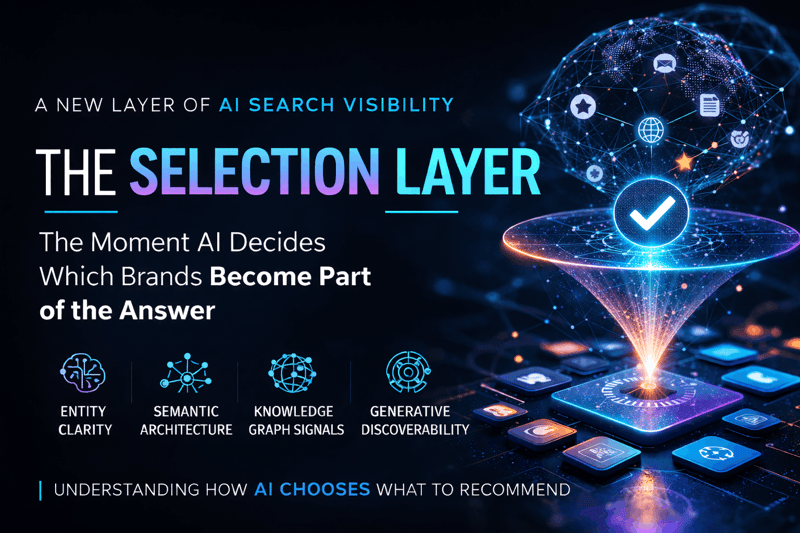
Netsleek outlines a framework explaining how artificial intelligence systems determine which entities are included in generated answers. The mechanisms that shape visibility on the internet are entering a new phase of transformation.
The Shift From Retrieval To Resolution
For more than two decades, digital discovery has been governed by retrieval-based systems. Search engines indexed content, assessed relevance, and presented ranked lists of results. Visibility was largely determined by position within these lists.
Artificial intelligence is now introducing a different structure. Modern AI systems increasingly resolve information rather than simply retrieving it. Instead of presenting multiple sources, they interpret intent, assess available information, and generate a consolidated answer. In this model, users are no longer selecting from a list of results. The system determines which information is included.
Redefining Digital Visibility
This shift redefines how visibility works. Where traditional search focused on ranking, AI-driven discovery is centred on selection. A growing area of AI search strategy describes this mechanism as the Selection Layer — the stage within AI systems where potential sources are evaluated and chosen for inclusion in generated responses.
According to Netsleek, an AI Search & Brand Discoverability agency, this layer represents a key structural development in how information is surfaced online. The Selection Layer can be understood as the decision environment in which AI systems determine which entities, organisations, and knowledge sources are sufficiently relevant and trustworthy to form part of an answer.
Within this model, visibility is no longer defined solely by where information appears in search results. Instead, it is influenced by whether an entity becomes part of the generated response itself.
The Evolution Of Search Systems
This reflects a broader evolution in the history of search. Early internet navigation relied on curated directories. Search engines later introduced algorithmic ranking systems to organise information. Artificial intelligence introduces a third stage — algorithmic resolution — where systems synthesise information and determine which sources contribute to an answer.
In this context, the primary mechanism is not ranking but selection.
Key Factors Influencing The Selection Layer
The Selection Layer framework outlines several structural factors that influence this process. One of these is entity clarity, which affects whether an AI system can accurately identify a brand, its expertise, and the areas in which it operates.
Another is semantic architecture, referring to how information is organised so that relationships between topics, services, and concepts can be interpreted by AI systems. A further component is knowledge graph reinforcement, where structured data, external references, and corroborating sources strengthen the system’s confidence in an entity.
In addition, generative discoverability describes how organisations appear within AI-generated responses, rather than only within traditional search listings. Together, these elements influence whether an entity is included in the set of sources considered during answer generation.
Industry Implications And Emerging Signals
As generative interfaces increasingly shape how people access information, these mechanisms are expected to play a more significant role in determining digital visibility. Industry observers have already begun noting the implications.
AI systems, including large language models and conversational search interfaces, evaluate multiple signals when producing responses. These include entity prominence, consistency across sources, semantic relationships, and external corroboration. The Selection Layer framework provides a way to interpret how these signals interact during the generation process.
Share Of Model And Future Visibility
According to Netsleek, organisations that align their digital presence with these mechanisms are more likely to be included in AI-generated responses across different prompts and contexts. The agency refers to this as Share of Model — a concept describing how frequently a brand appears within AI-generated answers across varying queries and scenarios.
While traditional optimisation strategies focused on improving ranking positions, the emergence of AI search is shifting attention toward how entities are selected, interpreted, and represented within generative systems.
As AI continues to reshape how information is discovered, frameworks such as the Selection Layer are expected to become increasingly relevant in understanding digital visibility. In this environment, the central question changes. It is no longer only about where a brand appears. It is about whether the system includes that brand in the answer itself.
Read our research paper here: https://www.netsleek.com/netsleek-research/the-selection-layer/
About Netsleek
Netsleek is an AI Search & Brand Discoverability agency specialising in Answer Engine Optimisation (AEO), Generative Engine Optimisation (GEO), and AI Search Architecture. The organisation focuses on helping brands structure their digital presence so that artificial intelligence systems can clearly interpret, trust, and reference them when generating answers.
This includes strengthening entity clarity, improving semantic architecture, reinforcing knowledge graph signals, and increasing generative discoverability across AI-driven environments.
Get new press articles by email
Netsleek is a global AI Search Optimisation agency. We prepare your website for the next era of visibility, where AI assistants choose which brands to recommend. Our core services include AI Search Optimisation (AISO), Answer Engine Optimisation (AEO), and Generative Engine Optimisation (GEO), supported by SEO foundations and content engineering.
The Pulse Latest Articles
- South African Women Are Missing This Essential Nutrient (May 20, 2026)
- Opinion Piece: Rethinking Performance: Why Behaviour Remains The Missing Link In Evaluation (May 20, 2026)
- 125 Years Of Hansgrohe And The Designers Who Made Axor A Luxury Language (May 19, 2026)
- World Whisky Day: Whisky Lovers Challenged To Stop Saving Their Best Bottles (May 15, 2026)
- Hidden Inefficiencies Are Draining South African Businesses (May 15, 2026)